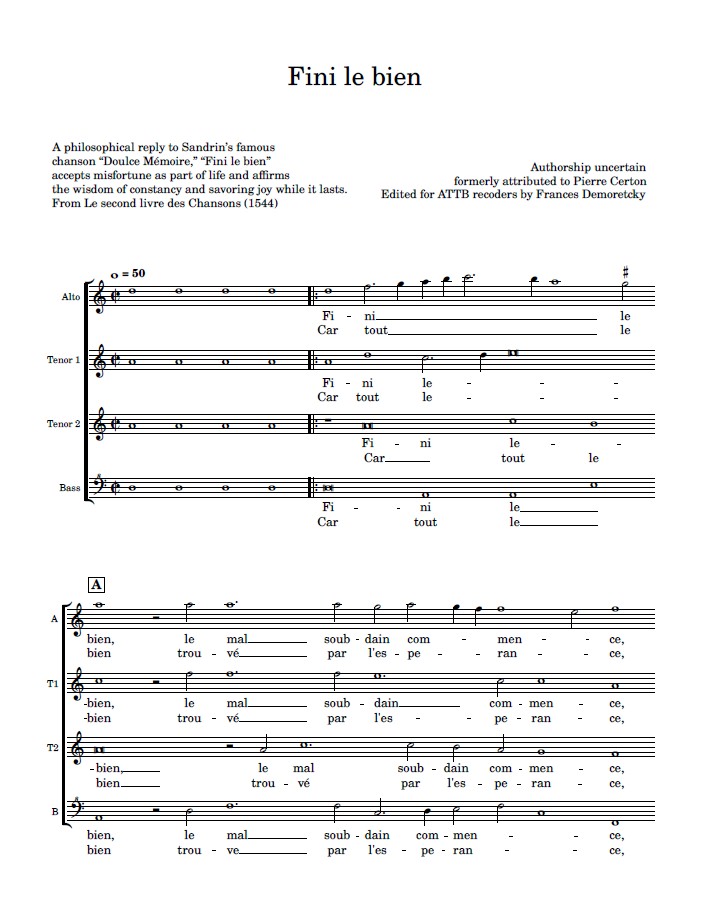
From Chanson to Credo: A Journey Without Barlines This barless transcription of Fini le Bien by Anonymous for ATTB recorders is part of a broader exploration of Pierre Sandrin’s iconic chanson Doulce Memoire and its expressive legacy. Presented at the Carolina Mountain Recorder Society, the project traced the emotional and structural transformation of Doulce Memoire across five distinct settings: Sandrin’s original chanson; a reflective duet by Pierre de Manchicourt; a graceful trio by Josquin Baston; this philosophical reply Fini le Bien by an anonymous composer; and Orlando di Lasso’s sacred reimagining in mass form.
Fini le Bien, posted here, responds to Sandrin’s chanson with philosophical acceptance. The original text serves as an epigram: a melancholic meditation on memory’s power to evoke sorrow, where sweetness is inseparable from pain and constancy feels tragically out of reach. This reply affirms the wisdom of savoring joy while it lasts and embracing misfortune as part of life.
The four related transcriptions mentioned above—Sandrin’s chanson, Manchicourt’s duet, Baston’s trio, and Lasso’s mass—can be found on the ARS website by entering “barless” in the Keyword box. This collection invites modern ensembles to engage not only with historical repertoire, but with the emotional testimony embedded in its evolving musical language. For those new to playing barless music, you may wish to consult my article, “How to Play Barless Renaissance Music,” in the July 2025 issue of ARS NOVA.